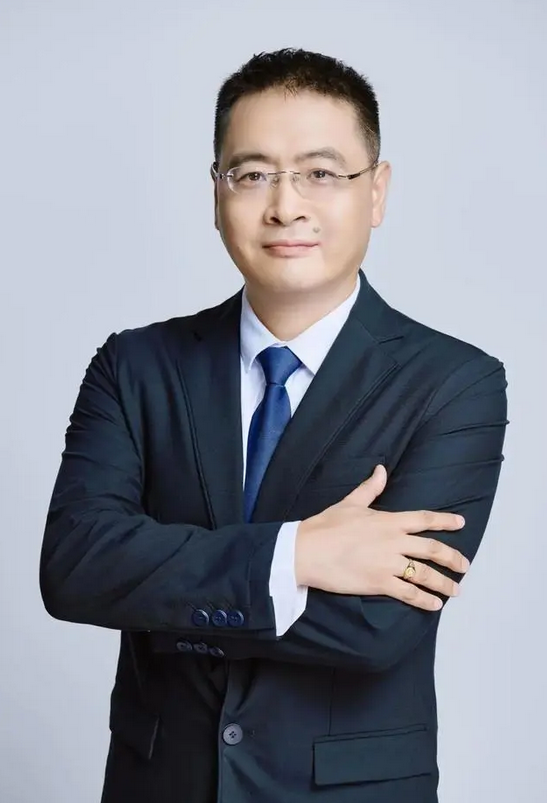
| Prof. Laurence T. YangZhengzhou University, China Biography: Laurence T. Yang is currently the Executive Vice President of Zhengzhou University, and serves as the Dean and Chief Professor of its School of Computer and Artificial Intelligence & School of Software. He is a Fellow of the Canadian Academy of Engineering (CAE), the Engineering Institute of Canada (EIC), and the Academia Europaea (The Academy of Europe). He is also a Fellow of IEEE, IET, and AAIA. He is a recipient of China's National High-level Overseas Talent program. Recognized as one of the world's top 1000 computer and electronics engineers, he is also listed in the Stanford University rankings of the world's top 2% of scientists and is a Clarivate Analytics Highly Cited Researcher. Additionally, he is a Distinguished Scientist of the Association for Computing Machinery (ACM). |
| Prof. Dapeng Oliver WuCity University of Hong Kong, Hong Kong Biography: Dapeng Oliver Wu received Ph.D. in Electrical and Computer Engineering from Carnegie Mellon University, Pittsburgh, PA, in 2003. Currently, he is Yeung Kin Man Chair Professor of Network Science, at the Department of Computer Science, City University of Hong Kong. His research interests are in the areas of artificial intelligence, communications, image processing, computer vision, signal processing, and biomedical engineering. He received University of Florida Term Professorship Award in 2017, University of Florida Research Foundation Professorship Award in 2009, AFOSR Young Investigator Program (YIP) Award in 2009, ONR Young Investigator Program (YIP) Award in 2008, NSF CAREER award in 2007, the IEEE Circuits and Systems for Video Technology (CSVT) Transactions Best Paper Award for Year 2001, the Best Paper Award in GLOBECOM 2011, and the Best Paper Award in QShine 2006. He has served as founding Editor in Chief of Transactions of Artificial Intelligence, Editor in Chief of IEEE Transactions on Network Science and Engineering, founding Editor in Chief of Journal of Advances in Multimedia, Editor-at-Large for IEEE Open Journal of the Communications Society, and Associate Editor for IEEE Transactions on Cloud Computing, IEEE Transactions on Communications, IEEE Transactions on Signal and Information Processing over Networks, IEEE Signal Processing Magazine, IEEE Transactions on Circuits and Systems for Video Technology, IEEE Transactions on Wireless Communications and IEEE Transactions on Vehicular Technology. He has served as Technical Program Committee (TPC) Chair for IEEE INFOCOM 2012. He was elected as a Distinguished Lecturer by IEEE Vehicular Technology Society in 2016. He is an IEEE Fellow. Title: Game Theoretical Artificial Intelligence (GTAI): a New Approach for Countering Threats Abstract: As humans, we are facing threats every day, from biological ones (such as diseases) to computer viruses to criminals. Battling these threats is a part of our daily life. Game theory has long been employed to design countermeasures to deal with the threats. Nevertheless, the game-theoretical countermeasures lack human-level intelligence, such as strategic planning. On the other hand, recently, AI has become an important weapon to tackle these threats, owing to the ever-growing power of AI. In this talk, I will present a new approach, called Game Theoretical AI (GTAI), which combines the Eastern wisdom (Sun Tzu’s “The Art of War” and the Thirty-Six Stratagems) with the Western wisdom (game theory) to combat intelligent opponents. |
| Prof. Yanchun ZhangZhejiang Normal University, China / Victoria University, Australia Biography: Yanchun Zhang is currently distinguished professor at Zhejiang Normal University, China and Emeritus Professor at Victoria University, Australia. He is Fellow of The Royal Society of Medicine of United Kingdom (FRSM), and Foreign Academician of Russian Academy of Natural Sciences (RANS). Prof. Zhang is a founding editor and editor-in-chief of Health Information Science and Systems Journal (Springer)and World Wide Web Journal (Springer)。 His research interests include databases, data mining, social networking, web services and e-health / digital health and information security. His research work has significantly impacted health informatics and information security, especially in developing data analytic skills and AI techniques for smart medicine and health. He has published over 500 research papers in international journals and conference proceedings. He authored/co-authored 5 monographs, and supervised 40 PhDs and post doctors in completion. He speaks regularly at international conferences in the areas of data engineering / data science and health informatics. He has serviced as an expert panel member at various international research funding agencies like Australia Research Council (ARC), UK's Medical Research Council (MRC) and Australia's National Health and Medical Research Council (NHMRC). Title: Medical Big Data / AI for Smart Medicine -- Toward Trustworthy AI in Digital Health |
| Prof. Shui YuUniversity of Technology Sydney, Australia Biography: Shui Yu is a Professor of School of Computer Science, University of Technology Sydney, Australia. His research interest includes Communication Science, Mathematical AI, and Cybersecurity. His current h-index is 90. Professor Yu initiated the research field of networking for big data since 2013, and mathematical AI since 2023. He is an editor IEEE Communications Surveys and Tutorials (Area Editor), IEEE Transactions on Cognitive Communications and Networking, and IEEE Transactions on Dependable and Secure Computing. He is serving as the Vice President of Technical and Educational Activities of IEEE Communications Society. He is a Fellow of IEEE. Title: Blind Computing: A New Frontier of AI, Service Computing, and Cybersecurity Abstract: AI application demands large scale data sharing, at the same time, participants have increasing concern on security and privacy. As a result, we are witnessing the appearance of blind computing, a new computing diagram in which a service provider executes a job correctly but possesses no knowledge about the job from input, algorithm, to output. It has been demonstrated that it is possible in quantum computing. However, there is a big gap between the demanding ideal service and the available techniques today. In this talk, we first introduce the phenomenon of blind computing, followed by the report of the current landscape of the field, and then present our initiative study in the machine unlearning case. We hope this talk will shed light to interested energetic researchers, and we can explore the promising uncharted land together. |